How will the Inflation Reduction Act play a role in fighting Climate Change?

On August 16, 2022, President Joe Biden signed the Inflation Reduction Act, a bill that will invest $369 Billion into climate solutions (EarthJustice). This act will invest in domestic energy production and manufacturing, putting us on the road to reducing carbon emissions by roughly 40 percent by 2030 (Senate Democrats).

The money set aside for environmental justice also stresses natural solutions regarding agriculture and forestry. These  “nature-based” climate solutions include about $20 billion for agricultural conservation and $5 billion to safeguard forests around the country (Congressional Research Service).

Relying on natural sectors does not discredit the energy sector’s efforts to reach net-zero through carbon capture and renewable energy infrastructure, but rather encourages both sectors to work in tandem. Humans must use trees, wetlands and other ecosystems that absorb carbon dioxide  to reduce Earth’s warming. However, if permafrost melts, forests are burned, marshes are drained, or wildfires rage, land also releases greenhouse gasses back into the atmosphere. These gasses that warm the globe occur from anthropogenic land mismanagement (deforestation and unsustainable farming).

According to The Washington Post, The Inflation Reduction Act would help strengthen current initiatives, such as a $700 million program to permanently protect forested land through conservation easements and local government purchases, $450 million to assist private landowners in better managing their forests, and $100 million to fund grants for environmentally friendly uses for wood. 

Along with these, this act includes tax reductions for electric vehicles, huge financial incentives to expand carbon-capture facilities, promoting green hydrogen production, and increasing renewables funding (wind, solar) in the United States (The Washington Post).

EarthJustice listed clean energy transition wins:

  • Expanding access to clean energy by making clean energy tax credits more accessible and extending them by 10 years.
  • Creating jobs and increasing our country’s energy security by investing $60 billion in manufacturing solar panels, batteries, and other clean energy technologies in the U.S.
  • Providing funding for low-income families to electrify their homes, including $9 billion in home energy rebate programs.
  • Removing barriers to community solar, an innovative solution to making solar power more accessible and affordable for the average person.

Check out What the Inflation Reduction Act Means for Climate for a more detailed list about the Inflation Reduction Act.

SCOTUS Limits EPA Powers to Repress Carbon Emissions

EPA Rundown

Associations like the EPA have managed to hold our major polluters accountable, ensuring America stays within its limits to reach UN SDGs and comply with COP21. On a specific note, the EPA has kept our air clean through enforcing the Clean Air Act preventing 230,000 early deaths and boosting our economy with the high benefits estimate exceeds costs by 90 times. Along with this, the Clean Water Act has been another benefit of the EPA, especially in situations like the Deepwater Horizon Oil Spill. 

This organization donates more than 40% of their funds to states to assist with their environmental efforts- and goes even deeper to hold companies accountable and monitor their emissions. (Top 10 Reasons We Need the EPA)

What Now?

The United States, home to only 4% of the global population, burns fossil fuels at a rate higher than the rest of the world. Second to China, America emitted 669.5 million metric tons of Co2 equivalents in 2020– meaning America is an important player in the battle of curbing carbon emissions. 

Recognizing this, Biden’s administration wants the U.S. power sector decarbonized by 2035.This is in line with the United Nations Sustainable Development goals and COP21 Paris agreements, stating that all countries would work to limit global temperature rise to well below 2 degrees Celsius. 

However, the US Supreme Court placed restrictions on the federal government’s authority to reduce carbon emissions from power plants- going against President Biden’s plans. The West Virginia V. The Environmental Protection Agency is part of a conservative activist plan- many who have direct relationships with coal and oil manufacturers, to limit executive powers on combating global warming.  The Supreme Court was asked to decide whether the 1970 Clean Air Act permits the E.P.A. to impose broad controls on the electricity industry or restricts it to imposing adjustments at specific power plants. Republican attorneys and coal companies argue that EPA regulations impact the economy and these rules should be set up by Congress, rathe than federal agencies (i.e. the EPA). 

The court’s 6-3 decision limited the Environmental Protection Agency’s (EPA) control of GHG emissions from current coal- and-gas-fired power plants. According to the New York Times, “this ruling curtails the E.P.A.’s ability to regulate the energy sector, limiting it to measures like emission controls at individual power plants and ruling out more ambitious approaches like a cap-and-trade system without the intervention of Congress.” This means the government does not have the power to force fossil-fuel based plants to more sustainable power sources.

Disclaimer: All these views are my own and do not reflect those of any affiliation.

Quick Thoughts on Lululemon’s Like New Program

“Like New” is Lululemon’s concept where customers can exchange their gently used pieces in stores for credit and buy previously owned apparel online (CNN). Though trade-ins are not accepted at outlets, they are accepted in all stores in the US. 

This idea uses closed-loop recycling, ensuring used clothes do not end up in landfills. Closed-loop recycling follows the process that recycles and reuses post-consumer products to supply the material used to create a new version of the same product (Road Runner).

After analyzing the program, it is clear that buyers have a better deal than sellers in this case. However, sustainability wise, 100% of this program’s profits are invested into their sustainability initiatives.

Initiatives include using less water, innovating more sustainable ideas and decarbonizing their value chain (Be Planet). 

Pros: Over 12,000 women’s clothing, transparent condition communication (gently used, good as new), prices are nearly 40% lower than original, returns are accepted within 30 days and all profits go to green-initiatives. 

Cons: Credit value is lower than reselling on other sites, not all items are accepted

The credit goes as follows:

•$5 – Shirts, Shorts, Skirts, $10 – Hoodies, Sweatshirts, Sweaters, Pants, Crops, Leggings, Dresses, Large Bags (Backpacks, Duffles, and Totes larger than 10L), $25- Outerwear

You can find a more detailed analysis here.

Overall, despite the lower credit value, this initiative works toward greater sustainable development goals, making it worth it long term. 

New Jersey Bans Plastic Bags in Stores

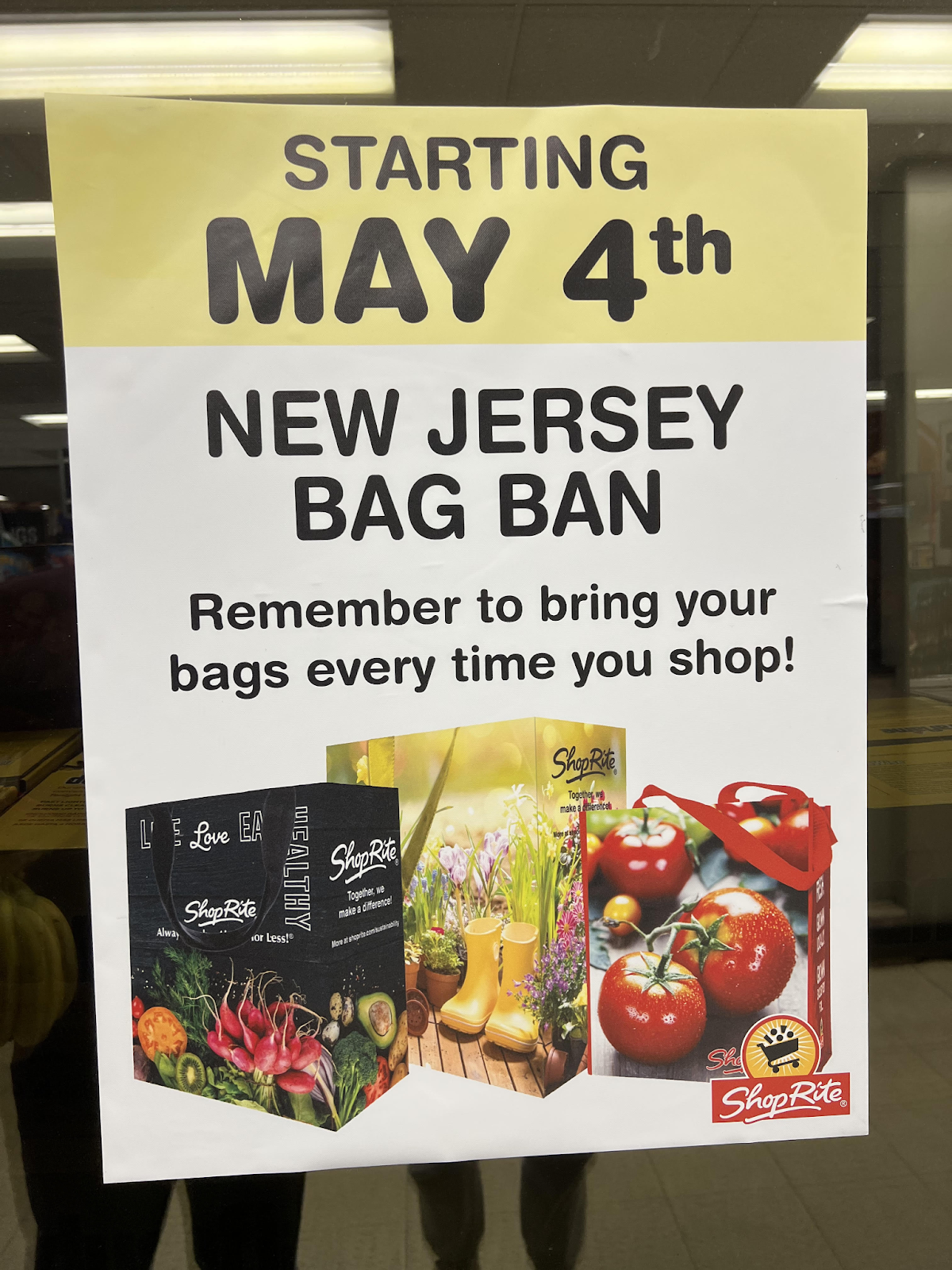
In November of 2020, Gov. Phil Murphy signed the plastic bag ban into law. This barred grocery stores from giving customers single use paper and plastic bags, and placed penalties into effect for those who violate the order. Single-use paper carryout bags are allowed to be provided or sold, except by grocery stores equal to or larger than 2,500 square feet, which may only provide or sell reusable carryout bags (Business.NJ.Gov). According to New Jersey Monitor, violators first face a warning, then a $1,000 fine that jumps to $5,000 for their third breach and any thereafter.

A pleasant greeting at my local Shoprite.

If the Department of Environmental Protection determines that there is no cost-effective non-plastic substitute, plastic objects might be added to the list of exemptions. Exemptions are valid for a year and can be renewed.

This law previously halted the distribution of plastic straws, ensuring that restaurants only provided them when specifically asked. 

The truth is, these laws have already shown tremendous impacts, with the upshot of the Sydney study showing the California bag ban reduced plastic bag consumption by 71.5% – a huge decrease (The Truth About Plastic Bags). 

Background

Plastic is never the better choice. Throughout both manufacturing and usage, it constantly pollutes and has proved to be hazardous. Furthermore, it is a dangerous threat to marine and land-based species and in the end, must be destroyed or buried, even after a lifetime of being recycled. Bag bans will not solve the plastic challenge on their own, but they will assist to shift plastic consumption habits and encourage consumers and retailers to consider alternatives (Conservation Law Foundation).

The Dangers of Single Use Plastic (Conservation Law Foundation)

All in all, even in a world pre-ban, consumers are more likely to bring reusable bags when penalties on paper bags are included in single-use plastic bag bans. A cotton bag can be reused hundreds of times and composted after it’s no longer needed. With all this considered, plastic is always more harmful and damaging than the alternatives.

How is Deforestation Caused by the Fashion Industry?

When we talk about Fast Fashion’s environmental impact, I’m sure the first thing that comes to mind is the waste pollution associated with the clothing production. However, right beside the climate footprint is the deforestation footprint caused by this industry. 

First, it is important to note the importance of forests. They are responsible for life on Earth, to put plainly. According to the World Wildlife Fund, “They purify the air we breathe, filter the water we drink, prevent erosion, and act as an important buffer against climate change.” Essentially, we know that the world runs on a loop, and everything does its own job to reach that stage of equilibrium. 

As humans, one of the primary anthropologist causes of global warming is the abundance of carbon dioxide emissions. However, forests play a role in finding a middle ground (our CO2 release through inhaling their oxygen). And the circle continues. But you knew that already. 

Research shows that 48% of fashion’s supply chain is linked with deforestation. The demand on cutting trees for fabric production is estimated to double by 2050. 70% of all clothing produced by such fibers end  up in landfills every year. Landfills that are created after the major clear cutting of vital forests. According to Kleiderly, fabrics from rainforests account for 5% of the total 1.2 trillion dollars in the textile industry globally, with this number growing at a 9% rate annually. 

Furthermore, the clear cutting of forests for landfills and lack of carbon emission mediation do not begin to address the full human impact. According to non-profit Canopy, more than 200 million trees are logged each year to be transformed into cellulosic fabrics like viscose and rayon. The organization notes that if these trees were placed end-to-end, they would circle our planet seven times. We use trees to make fabrics for the clothes we use so mindlessly. These trees live for centuries, but they are being cut down for our 2 week-long garment trends. 

So now we know about the impacts; the question of what we can do remains. 

  1. Avoid all uncertified viscose and rayon
    1. Some of these products are specifically planted for garment creation, so its better to use these. 
  2. Use alternative sustainable material
    1. Tencel
      • Tencel is made from fast-growing Eucalyptus trees grown specifically to create the material
      • No biodiverse forest risk involved
      • Closed loop recycling 
    2. Ecovero
      • Made by the same company which created Tencel, Lenzing
      • Made from ‘certified renewable wood sources using an eco-responsible production process by meeting high environmental standards’
      • Manufactured with up to 50% fewer emissions and water impact than generic viscose

Check out my other blog: 9 Sustainable Fabrics To Be On The Lookout For for more on the fabrics perspective.

In the end, everything is related. We know the fashion industry is the second largest polluter in the world, and this unfortunately does not stop at carbon emissions. 

The environment is interconnected, everything is an ecosystem- so if one part is impacted, the whole biosphere goes haywire. 

Fashion Industry’s Impact On Biodiversity

We know about the fashion industry’s impacts in relation to climate change, with the abundance of pollution, resource usage, and wasteful creation/disposal tactics. On a more specific note, apparel production plays a huge role in biodiversity disruption, from habitat loss to direct field sports. According to an article by McKinsey, “Apparel supply chains are directly linked to soil degradation, conversion of natural ecosystems, and waterway pollution” (Biodiversity: The next frontier in sustainable fashion); meaning the sustainability of general ecosystems are threatened by the ever-growing fashion industry. 

It is clear that biodiversity loss and climate change have a reciprocal relationship. For example, deforestation leads to increased climate change (due to an abundance of CO2 emissions), and in turn, rising temperatures lead to habitat destruction and biodiversity decline. 

An analysis by McKinsey and Company determined that most of the negative impact comes from three stages in the value chain: raw-material production, material preparation and processing, and end of life. This is primarily determined by land use, water use, and energy consumption. 

Based on their findings, they pinpointed the top five sectors that contribute to biodiversity loss: cotton agriculture, wood-based natural fibers/man-made cellulose fibers (MMCFs), Textile dyeing and treatment, and Microplastics and waste. 

With these sectors being incredibly important in the manufacturing industry, they have recognized that there is no viable solution that includes getting rid of said-sectors completely. Solutions overall include scaling up the company’s sustainability-focused quarters. 

To improve the sustainability of cotton, MMCFs, and synthetics, multiple technologies have already been established. Precision agriculture, integrated pest management (IPM), and micro-irrigation reduce water and chemical intensity to a certain extent. With efficient technology, there are always trade–offs, whether it be cost or guaranteed quality- however a mix of different variables can concoct more feasible solutions. 

Additionally, investing in innovative fabrics can pave the way for organic, biodegradable and renewable materials to be turned into clothing. Reusability goes hand-in-hand with renewing. Not only do recycled fibers repurpose trash, but they also have a reduced biodiversity footprint than virgin fibers.

By maintaining a strong stance on land and water pollution, on the barest level, companies will be able to protect ecosystems from further harm- consequently protecting their biodiversity. 

Take a look at McKinsey and Company’s comprehensive analysis of the fashion industry’s role in the circle of biodiversity! 

Biodiversity: The Next Frontier in Sustainable Fashion

How is fast fashion culture exaggerating the effects of plastic pollution?

The general picture that comes to mind after hearing “Plastic Pollution” probably consists of plastic bottles and bags clustered together on roads, waterways and neighborhoods. While these everyday plastics do fit the description, plastic pollution does not solely describe garbage visible to the naked eye. 

Different industries release different forms of “microplastics”- defined as “fragments of any type of plastic less than 5 mm in length,” according to the U.S. National Oceanic and Atmospheric Administration and the European Chemicals Agency. 

The severity of the issue microplastics bring when discussing water pollution is quite unfathomable when considering its’ miniscule size. However, most people fail to recognize that the majority of the plastic floating in the ocean does eventually break down into smaller pieces. Only 6% of plastic pollution in the ocean is visible, because the rest breaks down and sinks to the ocean floor, polluting food webs and habitats. 

Many microfibers originate from clothing materials, like polyester and nylon- which come from synthetic fibers, i.e. plastic. In 2016, 65 million tons of plastic was produced for textile fibers, representing close to 20 percent of the total plastic production for that year. Not only that, but plastics from the fashion industry are responsible for generating enormous amounts of wastewater and emitting huge quantities of carbon (How Plastic Pollution).

While these statistics can be attributed to the fashion industry in general, the pace at which fast fashion moves multiplies its’ own environmental effects. A New Textiles Economy: Redesigning Fashion’s Future, published by Ellen MacArthur Foundation in 2017, noted how the fast fashion industry has increased demand for plastic-infused clothing in recent decades due to quicker turnaround of new styles, increased clothing seasons per year, and lower prices. Fast fashion relies on massive new plastic production to fuel growth. According to the report, virgin plastic accounted for 63 percent of clothing materials used in 2015, compared to less than 3% recycled material (How Plastic Pollution). 

Basically, because of the constant weekly trends set up by fast fashion companies, they fall into a cycle of overproduction and wastage, just to continue pumping out clothes to seduce buyers. Rather than sticking with classic styles and the general 4-seasons-per-year clothing releases, fast fashion has plunged into 52-season years, increasing clothing production by 13 times. And, for those who get sucked into staying up-to-date with Shein’s overwhelming new releases, they are forced to constantly buy new clothes to avoid looking blatantly behind.

To meet the UN Sustainable Development Goals, French President Emmanuel Macron introduced the Fashion Pact at a G7 meeting in 2019. The pact included 32 companies and 150 brands (including Gucci, Chanel, and Nike) containing a set of shared goals that the fashion industry could work towards to reduce their negative impact. “Clothing companies and brands are encouraged, but not mandated, to: 1) achieve zero greenhouse gas emissions by 2050, 2) restore natural ecosystems and protect species, and 3) reduce the use of single-use plastic. For example, Stella McCartney is eliminating virgin plastic in her collections by using recycled polyester and upcycling materials” (How Plastic Pollution is Being Woven into Fast Fashion Culture).

With this, if fashion companies reduce their fast mindsets and adhere to their sustainability goals, we can be on our way to reducing waste, and consequently plastic pollution. 

Noise Pollution in the Fashion Industry?

The fashion industry is known for its poignant impacts regarding the environment, particularly when we talk about emissions. Water wastage and disposal are the most frequently visited subjects, so today I’m here to talk about a less known, but equally bad sector of the industry: noise pollution. 

To build an empire within the world of fashion we need factories. Most developing countries are home to factories and factory workers, because popular brands provide jobs and housing by employing civilians and using their resources. Conversation on the humanitarian aspects of the fashion industry opens up another dimension, so the main focus here is the effects of the factories outside of the physical pollution we see. 

Textile industries always incorporate modern automated machines, however, ‘emissions of excessive noise and ambient sound at work in the textile industry have shown a noticeable increase’. Noise levels of 70 to 110 dB are commonly recorded in textile plants workrooms and allegedly the progress towards greater speeds has resulted in excessive noise levels, often exceeding 110 dBA in spinning and weaving mills (Ejigu, 2019) (Noisy Fashion). 

The reason these stats are important are because the noise does impact individual health to varying degrees. According to Noisy Fashion’s analysis, the latest data (EEA, 2019) concludes that ‘long-term exposure to environmental noise is estimated to cause 12,000 premature deaths and contribute to 48,000 new cases of ischaemic heart disease per year’ in Europe alone. Similarly, it is estimated that 22 million people suffer chronic high annoyance and 6.5 million people suffer chronic high sleep disturbance as a result of environmental noise exposure throughout the EU member states.

Industrialisation, transportation, and urbanization have historically pushed environmental noise to the limelight, and the sustainability of future growth and development may be jeopardized as a result of noise’s detrimental consequences. These consequences have an impact on people’s quality of life and well-being, as well as the potential to affect their physiological health. Recent data from large-scale epidemiological studies has conclusively connected environmental noise exposure to negative health outcomes. 

As a result, environmental noise must be viewed not only as a nuisance but also as a serious threat to public health.

NJ Beekeepers Association Visits EB Save Club

We’ve all heard “Save the Bees” almost the same amount of times we’ve heard “Save the Turtles”- but let’s take a moment to really talk about the impact bees have on our ecosystem. Being a keystone species, they play a critical role in pollinating our crops and generally being an important factor in almost every food web because of the job they carry out. They are important commercially for farming practices worldwide and it is estimated that about one-third of global food production requires animal pollination and that 80–90 per cent of this role is carried out by honeybees (We Need Bees).

The climate crisis whiplash phase we are currently living through is disrupting more than we can ever imagine. Along with rising water levels, ecosystem habitats, and consequently animals, are being constantly overwhelmed and deranged, with bees being no exception. The rain limits the ability of spring bees to collect food for their offspring and super hot summers reduce flowering plants which is associated with fewer summer bees the next year. Warmer winters also lead to reduced numbers of some bee species. 

With that being said, the importance of bees is yet to be talked about in our school curriculums, even in classes like Environmental Science, the specifics tend to be blurred upon. And so, green clubs such as SAVE (Students Against Violating the Environment) have taken it upon themselves to spread the word, this time inspired by the New Jersey Beekeepers Association. 

New Jersey Beekeepers Association

The CJBA (Central Jersey Beekeeping Association) is a branch of the New Jersey Beekeepers Association whose focus is to promote beekeeping throughout the state. The CJBA serves Middlesex, Mercer, Monmouth, Ocean and Burlington counties.

Their mission is to:

  • Promote and support all aspects of beekeeping in Central Jersey
  • Educate the general public about the benefits and importance of beekeeping
  • Dispel myths and misinformation concerning the honeybee
  • Promote the honeybee and the beekeeping industry
  • Provide resources and communication to the beekeeping community

After meeting with Secretary, Mrs. Angela Juffey through emails, I reached out to the organization to give our club a presentation about bees. 

“My role, as Secretary and Beekeeper, is to support the CJBA’s mission. While having 14 hives, I reach out to my community and give Honeybee presentations when requested. When the weather is cooperative, my “girls” travel with me in an Observation Hive to various garden clubs, schools, libraries, and Harvest Festivals.” – Mrs. Juffey

The presentation not only covered the role bees play in the environment, but their different types, roles in the hive and even how to become a beekeeper yourself. 

Some of the highlights of the presentation included:

  • Specifics on bees, The Queen, Workers and Drones
  • Honey bee collapse
  • Colony Collapse Disorder, Cons and how it happens
  • Raw honey vs. Pasteurized Honey (Ms. Juffey does collect raw honey from her beloved bees)
  • Honey Bee diseases, pests and predators
  • Bee behavior and communication
  • How to be a friend to the bees:
    • Plant bee friendly wildflowers and shrubs: crocus and snowdrop, lavender, thyme, sage, etc.
    • Bird bath for thirsty bees
    • Dandelions have a lot of nectar for bees, so do not pick them near bee hives!!!
    • Make your own bee house – hollow bamboo shoots in a flower vase
    • Become a beekeeper
    • Always face hives east to get the bees out as soon as sun rises

As the Vice President of SAVE Cub, on behalf of all of us, I’d like to thank NJ Beekeepers Association and the wonderful Ms. Juffey for such an insightful presentation. 

Take a look at https://www.njbeekeepers.org/ to learn more!

Is Carbon-Capturing Clothing Possible?

The Green Revolution in the 1950s made way for numerous sustainable projects on the basis of reducing carbon emissions and air pollution- which were at the highest levels ever seen following World War 2. As technology advanced, by the time we reached the 70s, scientists were able to trace disastrous climate reactions to the heating up of the atmosphere because of the unstopped emissions. The idea of Carbon-capturing technology (CCUS- Carbon Capture, Utilization and Storage) came into place as a method of capturing emissions before they were released into the atmosphere, and following collection they would be converted into another energy form. However, with the Cold War and rise of nuclear warfare, the cost of sustainable energy sky-rocketed while research on their efficiency declined. So, CCUS did not get the time or money it needed for development and never became reliable enough for our daily use. 

Its all changing now, though. 

Currently, there are 21 large-scale CCUS projects for reducing factory emissions around the world. Over the past ten years, technology has been able to make carbon capture processes cost up to 70% less than before with new solvents and chemical “sponges” to capture CO2 and catalysts to speed up the CCUS processes.

Now, with these improvements on energy efficiency, we need to consider which industries must begin their transition into utilizing these technologies. Of course, those with higher contributions to overall emissions must prioritize green energy- namely, the fashion industry. In 2018, the fashion industry was responsible for 10% of global carbon emissions and nearly 20% of wastewater (mostly attributed to jeans production). Moreover, fast fashion is one of the most wasteful sections in the garment line, their very ideology of cheap clothing for cheap prices puts up major red flags. 

Keeping that in mind, certain designers have begun researching carbon–capturing type clothing, so the garments can limit their negative impact through material usage. Post Carbon Lab was founded by Dian-Jen Lin, a London College of Fashion graduate from their fashion futures program, and Hannes Hulstaert, an Architecture graduate of the University of Antwerp. Their mission in creating the company was to promote something they call Regenerative Sustainability Activism, which they describe as “making sustainability as easy and accessible as daily conveniences like putting on clothes and commuting,” which includes designing garments with photosynthetic and pollution-filtering properties to reduce the environmental impact of the fashion industry (Caldas).

As of right now, the garments feature a “living algae coating, consisting of layers of photosynthetic micro-organisms that can turn carbon dioxide into oxygen [and glucose].” To keep the algae alive and carbon-capturing, though, the outfits need to be looked after as if they were almost like plants. Caring procedures include daily watering, ph neutral detergent washing when needed, direct heat prevention, and storage in well-lit, ventilated spaces (Caldas). 

This is still an upcoming idea, and will take more time to create real SUSTAINable clothing that will last long enough to be viewed as slow fashion, without needing so many resources to ensure it’s wearability. 

To conclude with a statement from the producers, “We love how each piece has turned out and how accessible they are for people looking to make a statement and reduce their carbon footprint.” Despite the fact that the collection is only a designer concept, it demonstrates how, as time goes on,  more enterprises will seek to reduce their carbon footprints through further investigation, research, and experiments to ensure a brighter, greener future.

Take a look at Is Carbon-Capturing Clothing the Possible Future for Fashion? for more!