In a Turn of Events: Exxon Sues Climate Activists

ExxonMobil, long under scrutiny for allegedly downplaying its role in climate change, has taken an assertive stance by suing two activist investor groups, Arjuna Capital and Follow This. This lawsuit marks a significant escalation in the ongoing battle between corporations and climate activists, spotlighting the tensions surrounding corporate responsibility in addressing global warming.

Shareholder proposals are a common mechanism for investors to influence corporate policies, especially concerning environmental issues. Arjuna Capital and Follow This have persistently submitted proposals urging ExxonMobil to accelerate its reduction of greenhouse gas emissions, particularly targeting Scope 3 emissions. These emissions, which stem from the use of Exxon’s products, constitute the majority of the company’s carbon footprint. ExxonMobil contends that these proposals are politically motivated and aimed at micromanaging the company rather than enhancing shareholder value.

In a notable departure from the norm, ExxonMobil’s lawsuit seeks judicial clarification of the rules governing shareholder proposals, rather than relying on the SEC (U.S. Securities and Exchange Commission). The SEC’s 2021 guidelines made it more challenging for companies to exclude proposals, prompting ExxonMobil to argue that court intervention is necessary to prevent the misuse of the shareholder proposal process. The company insists that this legal battle is not about climate change per se but about ensuring proper governance and adherence to SEC rules.

The case underscores the growing tension between companies and activist investors over corporate climate responsibilities. If successful, ExxonMobil’s approach could set a precedent, leading to increased corporate litigation against similar activist initiatives. This move could potentially intimidate shareholders from submitting proposals on climate issues in the future, reshaping the landscape of shareholder activism and corporate governance concerning environmental accountability.

Activist groups argue that their proposals are crucial for addressing climate change and holding companies accountable. Critics of ExxonMobil’s lawsuit view it as an attempt to silence shareholder activism and stifle important discussions on environmental issues. Josh Zinner, CEO of the Interfaith Center on Corporate Responsibility, warns that this tactic might discourage shareholders from raising critical climate concerns, undermining efforts to hold companies accountable for their environmental impact.

Other corporations are closely monitoring the outcome of ExxonMobil’s case. Charles Crain of the National Association of Manufacturers highlights a broader frustration within corporate America regarding the shareholder proposal process, especially on contentious issues like climate change. Companies may increasingly turn to the courts if the SEC continues to allow proposals they view as politically motivated.

ExxonMobil’s lawsuit against Arjuna Capital and Follow This is a pivotal moment in the intersection of corporate governance and climate activism. The outcome could significantly influence how companies and activists engage on environmental issues, potentially reshaping the future of shareholder activism and corporate accountability in addressing climate change. As global temperatures rise and the urgency for climate action intensifies, this legal battle exemplifies the complex dynamics between corporate policies and environmental sustainability.

Refer to US state officials urge votes against directors as Exxon sues climate activists and ExxonMobil is suing investors who want faster climate action for more.
The Causes and Effects of Water Shortage

Inefficient water management, excessive use and climate change are contributing to increasing droughts and water shortages globally. These issues not only threaten public health but also lead to food insecurity and conflicts over water, highlighting the urgency of protecting and sustainably managing water resources.

Droughts, increasing demand and water pollution are main causes of water shortage.

Droughts, intensified by climate change, are a major factor in water scarcity. Rising global temperatures disrupt rainfall patterns, increase evaporation rates, and lead to severe heat waves that exacerbate drought conditions. According to the 2018 Intergovernmental Panel on Climate Change (IPCC) report, groundwater, which supplies 36% of the world’s domestic water, is highly vulnerable to climate change. For example, the Yangtze and Yellow Rivers in China are experiencing reduced water flow due to glacial melt caused by global warming.

The world’s population is approaching eight billion, driving up water demand, particularly in urban areas with limited water supplies. Cape Town, South Africa, nearly ran out of drinking water in 2018 due to a combination of severe drought, poor management, and overconsumption. Similarly, China faces significant water scarcity, with its renewable water resources per capita far below the global average.

Pollution also further reduces the availability of safe freshwater. Contaminated water from untreated wastewater and agricultural runoff diminishes the already limited supply of drinkable water. With less than 1% of the Earth’s freshwater accessible, pollution poses a severe threat to both human health and the environment.

Food insecurity and increased human conflicts are notably key impacts of water shortage.

Water is crucial for food production, with about 70% of freshwater used in agriculture. Severe droughts, such as those in the Horn of Africa, have devastated crops and livestock, leading to food shortages and high malnutrition rates. The UN has warned that worsening conditions could lead to a humanitarian crisis.

Water scarcity often leads to conflicts over access to water resources. In India, local disputes over water usage have escalated, and the country has ongoing water-related tensions with Pakistan. Similarly, Egypt’s water supply is threatened by Ethiopia’s Grand Renaissance Dam on the Nile, which could lead to potential military conflict.

Addressing water shortages requires global cooperation to mitigate climate change, improve water management, and reduce pollution. Adopting sustainable practices and policies is essential to ensure the availability of this vital resource for future generations.

Brief Rundown of CoP28 So Far

CoP28: The 2023 United Nations Climate Change Conference or Conference of the Parties of the UNFCCC

As we pass the midpoint of the 28th session of the Conference of the Parties (CoP28) to the UN Framework Convention on Climate Change in Dubai, several significant initiatives and commitments have been made. Here’s a breakdown of the key updates and focuses of CoP28 so far:

Climate Finance Initiatives

The President of the UAE, Mohammed bin Zayed Al Nahyan, announced the establishment of a $30 billion fund dedicated to global climate solutions, aiming to attract an investment of $250 billion by the end of the decade. Additionally, participants pledged $700 million to assist lower-income countries in coping with losses and damages caused by climate change. The presidency also introduced 10 principles to ensure that finance for climate solutions is available, accessible, and affordable.

Agricultural Emissions Agreement

Over 130 countries signed a declaration to incorporate emissions from agriculture into their national climate plans. A coalition of more than 25 leading food and agriculture organizations committed to scaling regenerative agricultural practices. This initiative involves partnering with 3.6 million farmers to transition over 160 million hectares of land to practices that protect the soil and limit carbon emissions.

Renewable Energy and Efficiency Targets

Around 118 countries have agreed to set targets to triple renewable power generation capacity to 11,000 GW and double energy efficiency within this decade. This agreement marks a significant step towards accelerating the global transition to renewable energy sources.

Methane Emission Reduction Pledge

Fifty oil and gas companies pledged to reach near zero methane emissions by 2030, with required plans to meet these targets by 2025. Additionally, a fund was announced to support methane abatement projects in emerging markets and developing economies. These companies also agreed to achieve net zero greenhouse gas emissions from their operations by 2050.

Health and Climate

For the first time in its history, CoP28 dedicated a day to health, recognizing the connection between a healthy planet and healthy people. This highlights the increasing acknowledgment of the impact of climate change on public health.

Progress of the Global Stocktake

Evaluating National Contributions: The global stocktake reviews the Nationally Determined Contributions (NDCs) submitted by countries. These are the climate action plans that each country commits to under the Paris Agreement. The review helps assess whether current NDCs are sufficient to meet the target of limiting global warming to well below 2°C, preferably to 1.5°C, above pre-industrial levels.

Identifying Gaps and Opportunities: By comparing the aggregate effect of the NDCs with the overall climate goals, the stocktake identifies gaps where countries need to increase their ambitions. This assessment is crucial for understanding where additional efforts and resources are needed and for highlighting successful strategies that can be replicated.

Informing Future Actions: The insights gained from the stocktake are intended to inform the next round of NDCs, which countries will submit in 2025. This cyclical process aims to progressively enhance global climate action over time, ensuring that countries can adjust their policies and actions based on the latest scientific data and technological advancements.

In Summary

Evidently, CoP28 has addressed several key issues central to climate action. However, the effectiveness of these initiatives will depend on the actual implementation of these commitments. The Intergovernmental Panel on Climate Change (IPCC) has stated that to limit global warming to around 1.5°C, global greenhouse gas emissions must peak before 2025 and be reduced by 43% by 2030. A stark report from the UN Climate Change indicates that the world is on track for a 2.5°C warmer world by the end of the century based on current pledges by national governments. While CoP28 might have set the stage for ambitious climate action, the true impact will be measured by the tangible actions taken by countries and significant acceleration and commitment from all parties involved.

Take a look at Environmental News Update for more.

Does the Upcoming Space Race have Impending Environmental Responses?

In recent years, there has been renewed interest in space exploration, with both government space agencies and private companies contributing to advancements in the field. Companies like SpaceX, founded by Elon Musk, have played a significant role. SpaceX has achieved milestones such as the first privately developed spacecraft to reach orbit, the first privately developed spacecraft to dock with the ISS, and the development of the Starship spacecraft for potential missions to the Moon and Mars.

Other space agencies, including NASA, Roscosmos, and the European Space Agency, continue their space exploration efforts with missions to the Moon, Mars, and beyond. International collaborations, such as the Artemis program aiming to return humans to the Moon, also reflect the global interest in space exploration.

The impact of the space race on the environment depends on various factors, including the technologies used, the frequency of launches, and the disposal of space debris. 

Rocket Emissions: The launch of rockets involves burning fuel, and the combustion process emits greenhouse gases and other pollutants into the Earth’s atmosphere. However, compared to other industries, the space industry’s contribution to overall emissions is relatively small, so far. However, emissions in the shape of greenhouse gas emissions, stratospheric water vapor, soot and inductive chemical reactions could potentially grow to be harmful. 

  • The combustion of rocket propellants releases gases such as carbon dioxide and water vapor into the atmosphere. Though water vapor is a natural component of Earth’s atmosphere, the release of significant amounts of CO2 contributes to the greenhouse effect.
  • Rockets that reach the stratosphere can release water vapor directly into this upper layer of the atmosphere. Water vapor in the stratosphere can have a more potent warming effect than at lower altitudes, as it can persist for longer periods and contribute to the depletion of ozone. Though not directly classified as a pollutant, excessive anthropogenic water vapor can contribute to changes in atmospheric conditions and weather patterns.
  • The incomplete combustion of rocket propellants can produce black carbon particles or soot. When deposited on ice or snow surfaces, black carbon can reduce their reflectivity, leading to increased absorption of sunlight and contributing to local warming.
  • The interaction of rocket exhaust with the upper atmosphere can lead to chemical reactions that may produce substances like nitrogen oxides. These compounds can have various environmental effects, including potential impacts on ozone levels and air quality.

Space Debris: The space race contributes to the accumulation of space debris, which includes defunct satellites, spent rocket stages, and other fragments. While efforts are made to minimize debris, it remains a concern for space sustainability. Collisions or accidental debris generation during launches can exacerbate the issue.

Resource Extraction and Mining: Future space exploration initiatives may involve resource extraction from celestial bodies, such as the Moon or asteroids. The environmental impact of such activities would depend on the scale, methods used, and adherence to sustainable practices.

On the positive side, the space race can drive technological advancements that have applications beyond space exploration. Innovations in materials, energy efficiency, and waste reduction can have positive environmental impacts on Earth. However, it takes trial and error to reach this level of innovation, and years of material research add up to significant material and substance wastage.

It’s essential for space agencies and private space companies to consider environmental sustainability in their operations. As the space industry evolves, efforts to develop greener technologies and adopt sustainable practices should as well. 

Take a look at The New York Times’ take on this topic: The New Space Race Is Causing New Pollution Problems

What is the Willow Project?

The Willow Project was proposed by ConocoPhillips, and the company received initial approval for the project from the Bureau of Land Management (BLM) during the Trump administration. In October 2020, the BLM released a Record of Decision (ROD) that authorized ConocoPhillips to move forward with development of the project.

Once developed, the project would involve the construction of infrastructure, including drilling pads, pipelines, and processing facilities, to extract oil and gas from the area.

The proposed project has been controversial due to concerns about its potential environmental impacts on the area’s wildlife and ecosystem, as well as its contribution to climate change through the extraction and burning of fossil fuels. The project is currently under review by the Biden administration, which has expressed skepticism about the need for new oil and gas development projects in light of the urgent need to address climate change.

However, the Biden administration has since taken steps to review and potentially revise decisions made by the previous administration regarding the Willow Project and other energy development projects in Alaska. In January 2021, the administration announced a temporary moratorium on new oil and gas leasing on federal lands and waters, including in the National Petroleum Reserve-Alaska (NPR-A), where the Willow Project is located. The moratorium is in effect while the administration conducts a comprehensive review of the federal oil and gas program.

An environmental law organization called Earthjustice is anticipated to submit a complaint against the project soon. They will likely ask for an injunction to try to stop it from moving forward. ConocoPhillips and environmental organizations are battling the clock. Because Willow requires ice roads to create the rest of the oil project’s infrastructure, which includes hundreds of miles of roads, pipelines, and a processing plant, construction on Willow can only be done during the winter months. The winter season in Alaska could conclude around April, depending on the weather.

Construction could be delayed for at least a year if environmental organizations are successful in getting an injunction before that to halt or postpone the project. The oil poured out of Willow may take years to reach the market because the project must be completed before the oil can be produced.

The project, according to state’s legislators, will increase domestic energy output, create jobs, and reduce the nation’s reliance on foreign oil. On March 3, President Joe Biden and his top advisers met with the three members of Alaska’s congressional delegation to urge them to support the project.

A coalition of Alaska Native organizations on the North Slope defends the project and claims it may provide the area with an essential new stream of income, helping pay for services like education and healthcare.

“Willow presents an opportunity to continue that investment in the communities,” Nagruk Harcharek, the head of the advocacy organization Voice of the Arctic Iupiat, told CNN. 

Other Alaska Natives who live closer to the proposed project, such as municipal authorities and tribe people like from Nuiqsut, are extremely worried about the effects a significant oil development will have on their health and the environment.

Nuiqsut Mayor Rosemary Ahtuangaruak and two other city and tribal leaders said in a recent private letter to Interior Secretary Deb Haaland that the village will suffer the most from Willow’s effects on the community’s health and ecology. The letter claims that while other villages “get some financial benefits from oil and gas activity, they experience far fewer impacts than Nuiqsut.” “The industrialization of the Arctic is at its infancy here.”

Additionally, over one million letters were sent to the Biden administration opposing the initiative, and over 2.8 million people signed a Change.org petition to stop Willow in the previous week as a result of an uptick in online activity against it on TikTok.

Make sure to read more about the Willow Project and speak out! Contact your local government to reach higher platforms, sign petitions, and stay aware. 

New technology turns carbon dioxide into… a baking ingredient?

Carbon capture is an upcoming technology which involves the capture of carbon dioxide emissions from industrial processes, such as steel and cement production, or from the burning of fossil fuels in power generation. This carbon is then transported from where it was produced, via ship or in a pipeline, and stored deep underground in geological formations (National Grid)

Because the material is so thin, it is hard to capture CO2 from the air: Only about 400 of the millions of particles in the air contain carbon dioxide. However, even this small amount has a significant impact on the climate. Direct air capture machines pull air through filters that trap CO2 by chemically reacting with it. However, the current materials are unable to capture a lot at once, and the entire process consumes a lot of energy. It’s simpler to catch more at a concentrated wellspring of contamination like a coal power plant, however pulling the CO2 from the air enjoys the benefit of having the option to happen anyplace, and can likewise catch old discharges as the world creates some distance from petroleum products.

According to Fast Company, this CCS filter’s material was redesigned by Lehigh University researchers by adding copper, making it three times more efficient than the current model. Even more carbon can be captured by it than by a filter placed directly on a smokestack. “Our work showed that even at ultra-dilute concentration, the capturing capacity of CO2 can be . . . much higher than what other adsorbents are doing with point sources,” says lead investigator Arup SenGupta.

The whole process costs less when the material has more capacity; SenGupta believes that the industry’s goal of $100 per ton of CO2 captured could be easily achieved. This indicates that direct air capture will continue its rapid expansion. Only a few thousand metric tons of CO2 are currently being removed annually by the emerging direct air capture industry. Each of the new plants that are currently being built will be able to remove 1 million tons of CO2 annually. However, in order to achieve climate goals, scientists anticipate that by the middle of the century, an annual average of 6 billion tons of CO2 will need to be removed.

The new technology could capture CO2 and inject it underground, similar to how carbon is currently stored at an Icelandic direct air capture plant. However, due to the change in chemistry, it may also end up in the sea. After the channel tops off with carbon dioxide, running seawater through the material makes another compound response, delivering sodium bicarbonate, or baking pop. In theory, the baking soda could be thrown into the ocean. The alkalinity of the baking soda may be able to counteract ocean acidification, another effect of climate change, if this can be done safely and legally.

In total, capturing carbon naturally has already seen great effects, but by turning it into usable materials, our sustainability goals are twice likely to be met. 

Puma’s new sustainability initiative caters to Gen-Z!

Puma, the German multinational corporation that designs and manufactures athletic and casual footwear, apparel and accessories has stepped up their game in the sustainability world.

Puma’s new Voices of a RE:GENERATION program asks four environmentalists in their 20s for their opinions on how the company can handle important environmental and social issues. Over the course of a year, the four will be invited to a number of meetings with Puma officials and will be treated as “candid consultants” of the company’s existing sustainability strategy and initiatives. The meetings will include personnel with expertise in sustainability and sourcing.

The 4 participants include American Andrew Burgess AKA Wandy the maker, Germany based  lifestyle vlogger Luke Jaque-Rodney, UK-based documentary maker Alice Aedy, co-founder of Earthrise Studio media platform, and France-based creative consultant Jade Roche. 

Puma has not yet said whether it will continue the program after a year or invite new participants. The ‘Conference of the People’, which it sponsored in London last autumn, served as the catalyst for the initiative’s debut. While Puma employees were given speaking time at this event to address environmental innovation, the agenda was largely devoted to hearing from people pushing fashion businesses to enhance their practices.

According to Fibre 2 Fashion, Gen z and millennials are not only turning away from unsustainable brands but are embracing and willing to pay more for sustainable products. Surveys of gen z members have shown that 73 per cent of them are willing to pay more for sustainability, a majority of which were willing to pay up to a 10 per cent premium. These facts show the importance of large corporations using modern voices to make their own sustainability plans. 

Anne-Laure Descours, the head of sourcing at Puma, stated: “We’ve always documented our progress in sustainable practices. However our participation in Conference of the People has shed light on the fact that the information we share isn’t always easily understood by the next generation. We recognise the need for change, and we’re committed to making sustainability more accessible and transparent to everyone. Voices of a RE:GENERATION is our first step in improving this.”

This move is on top of Puma’s sustainable development goals that have already been set in place. They have already set a target to use 100% certified and/or recycled paper and cardboard by 2025. In 2021 they stood at 88% recycled goods. All paper bags used in PUMA stores as well as all our product hang tags are FSC certified, and PUMA shoe boxes use over 95% recycled paper content (Puma). 

Is Recycling Plastic a Myth?

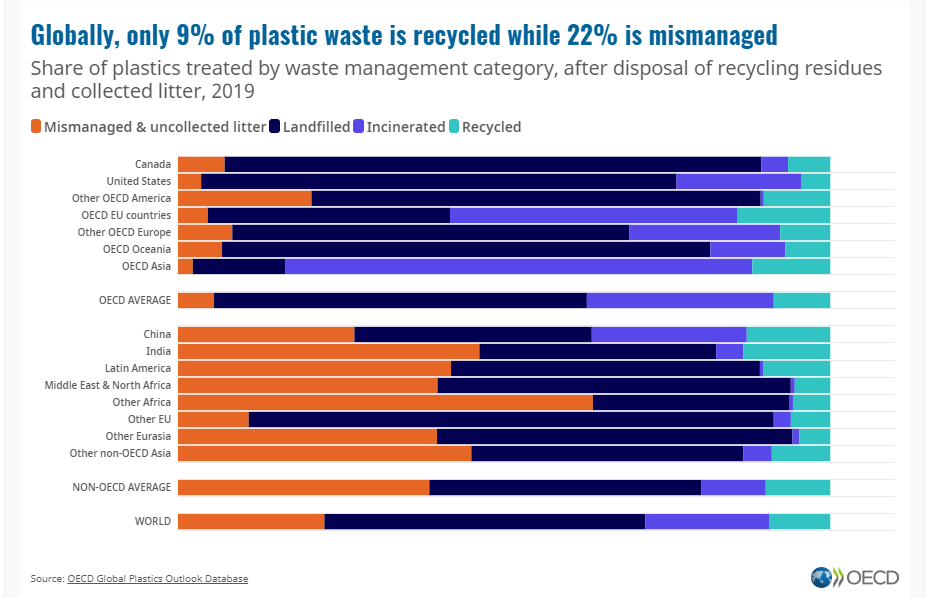
According to a new analysis by Greenpeace USA, plastic recycling is a myth. 

We know that the numeric carbon footprint of plastic production in itself is incomparable to other materials. Regarding plastic material’s entire lifecycle, they have a significant carbon footprint and emit 3.4% of global greenhouse gas emissions. 

Despite knowing this, most people justify their plastic indulges by claiming to be avid recyclers. However, to put plainly, plastic, which is made from fossil fuels, is notoriously difficult to recycle. There are thousands of different types of plastic, each with a unique chemical composition that can be divided into broad categories. Most must be carefully sorted in order to be processed because they can’t all be recycled at once. This is considered the largest hindrance to plastic-recycling’s success. The  thousands of different plastics containing their own composition, characteristics, chemical additives and colorants make it impossible to  recycle together. Then, considering the rate of production, consumption and usage, there are not enough resources to sort the trillions of pieces of plastics into separate types for processing (Enck and Dell).

Senior plastics campaigner for Greenpeace USA, Lisa Ramsden, said “If plastics were a country, they would be the fifth largest emitter of greenhouse gasses in the world.” According to International Organization for Standardization (ISO), “ plastic production is expected to double by 2040 and increase by 2.5 times by 2050.” This growth can be attributed to general industrialization, but also simple mismanagement of existing plastic. The release of microplastics into the ocean, littering, food takeaway packaging and sanitary yet unsustainable throwaway medical equipment add up to the statistics we see. 

The Greenpeace report also finds that “no type of plastic packaging in the U.S. meets the definition of recyclable used by the Ellen MacArthur Foundation’s New Plastic Economy (EMF NPE) Initiative. Plastic recycling was estimated to have declined to about 5–6% in 2021, down from a high of 9.5% in 2014 and 8.7% in 2018. At that time, the U.S. exported millions of tons of plastic waste to China and counted it as recycled even though much of it was burned or dumped.”

According to the OECD, “Bans and taxes on single-use plastics exist in more than 120 countries but are not doing enough to reduce overall pollution. Most regulations are limited to items like plastic bags, which make up a tiny share of plastic waste, and are more effective at reducing littering than curbing plastics consumption. Landfill and incineration taxes that incentivise recycling only exist in a minority of countries.”

Despite their good intentions, the 3Rs are no longer as reliable as they once were. Recycling cannot be an excuse for overconsumption. The first step is to reduce the materials we use in our daily lives, and then reuse what we already have. Essentially the way to avoid these recycling disasters is by not indulging in single-use plastics to begin with. 

The Science Behind Warming Waters

Carbon dioxide generally dissolves in water. This is why the oceans are responsible for  absorbing about 30-50% of the CO2 produced from burning fossil fuels. Cold water is better at dissolving and absorbing gasses like CO2 compared to warmer water, which is why a large amount of it gets dissolved in the ocean’s chilliest waters. This is generally speaking. 

Now, with ocean temperatures on the rise, rather than absorbing co2, oceans are beginning to release it. According to Or Bialik, a geoscientist at the University of Münster in Germany, it’s the same thing that happens in a bottle of soda that is carbonated with carbon dioxide. “You usually keep it cold, so the dissolved gasses will stay dissolved. If you leave it in your car for a while and try to open it, all the gasses are going to pop out at once, because when it warms, the capacity of the fluid to hold CO2 goes down.” 

With this development, came the formation of carbonate crystals in the Mediterranean Ocean. Experiments done by Bialik and team proved Aragonite, a type of calcium carbonate, was forming abiotically. These crystals are generally used in marine animals as part of their protective shell. However, in addition to the rising sea temperatures creating dissociated crystals, the calcium carbonate within marine shells are simultaneously breaking down as a result of varying pH. 

The absorption of carbon dioxide creates carbonic acids, which introduces free hydrogen ions that form with carbonate ions, resulting in fewer carbonate ions for the shells of marine organisms, therefore, these organisms have smaller shells. The ocean’s pH ranges from 7.5 to 8.4, but increasing carbon dioxide levels correlates with a decreased pH, which interferes with marine organisms’ ability to form calcium carbonate shells. Essentially, if the pH is lowered, then the calcium carbonate shells of marine organisms will break down because they act as a buffer to stabilize increasing acidity in the water.

These are interesting, contrasting phenomenons that are further explained in Matt Simon’s Wired Article on the Mediterranean forming carbonate crystals. “As these crystals form, they release CO2. So much so, Bialik calculates, that they account for perhaps 15 percent of the gas that the Mediterranean Sea emits to the atmosphere.

As the sea warms up and loses its CO2, both from the water belching it up and from the proliferating crystals, its acidity actually goes down. This is the opposite process from the one that’s causing widespread ocean acidification: As humans spew more CO2 into the atmosphere, the oceans absorb more of it, and the ensuing chemical reaction raises acidity. Acidification makes it harder for organisms like corals and snails (which are known collectively as calcifiers), to build shells or exoskeletons out of calcium carbonate. But as the Mediterranean warms and releases its absorbed carbon back into the atmosphere, it gets more basic, reversing that acidification.”

For more on this topic visit The Mediterranean Sea Is So Hot, It’s Forming Carbonate Crystals.

For a more in-depth summary on the evaluation of pH, temperature and calcium carbonate breakdown, take a look at my AP Environmental Science lab report: Ocean Acidification Lab

What is Tidal Energy?

Tidal energy is a renewable energy powered by the natural rise and fall of ocean tides and currents (National Geographic). Generally, these energy sources are developed in areas where there is a high difference between high and low tide, to maximize the potential energy derived. Though Tidal Energy has not yet developed to be produced on a large scale, scientists have continued its research as it could be a potential non-renewable energy source replacement. 

Tidal Energy generators include tidal streams, barrages and tidal lagoons.

Similar to how wind turbines function, turbines are placed in tidal streams to take the fluid energy and convert it to usable electricity. Because water is much more dense than air, tidal energy is more powerful, predictable and stable than wind energy (National Geographic). These turbines, however, are most effective in shallow water, which also allows for minimal disruption to water bodies, ships and aquatic ecosystems. 

Barrage, another tidal energy generator, serves as a large dam through which water is controlled from high to low tide. These barrages still use turbines as most energy sources require a “trigger,” most often replicated in the shape of a wheel. Barrages have a much larger environmental impact than tidal streams, as they require large, uninterrupted water bodies and serve as barriers to marine life. 

Functionally, barrages are similar to tidal lagoons, other than the fact that tidal lagoons can be constructed on natural coastlines. Because of the lack of heavy machinery, marine life is not threatened by the formation of these tidal lagoons. However, another result of the lack of machinery is the low energy output. 

Currently, the United States has granted $35 million in funding tidal and river current energy systems. Because of the minimal carbon footprint, many scientists have hope for this sector’s energy potential.Alejandro Moreno, who is acting assistant secretary for Energy Efficiency and Renewable Energy, said oceans and rivers represented “a huge potential source of renewable energy.” The Department of Energy (DOE) said the funding would come from the Bipartisan Infrastructure Law (CNBC).

Numerous tidal power-related projects, including some in the United States, have advanced significantly in recent years. For instance, the European Marine Energy Centre in the Orkney islands. began grid-connected power generation in July 2021 using what has been labeled “the world’s most powerful” tidal turbine. 

The use of tidal energy is steadily increasing. “In data released in March 2022, Ocean Energy Europe said 2.2 MW of tidal stream capacity was installed in Europe last year, compared to just 260 kilowatts in 2020. For wave energy, 681 kW was installed, which OEE said was a threefold increase. Globally, 1.38 MW of wave energy came online in 2021, while 3.12 MW of tidal stream capacity was installed. By way of comparison, Europe installed 17.4 gigawatts of wind power capacity in 2021, according to figures from industry body WindEurope” (CNBC).

Such facilities want to further test tidal turbine blades under demanding conditions, hoping it will hasten the advancement of marine energy technologies and reduce costs.